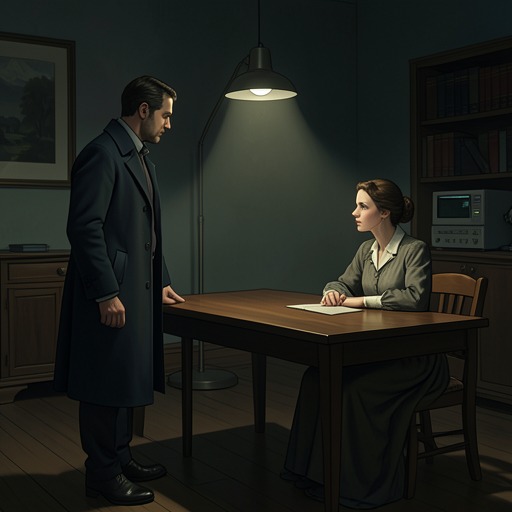
The KZ is that mirror
The Zone of InterestThe KZ is that mirror is a recurring expression that recasts an old tale of a magic mirror as a way of understanding the concentration camp. The mirror exposes the self beneath its reflection; the camp, in this formulation, exposes its inhabitants to who they are. Its decisive difference is also its threat: the truth cannot be avoided by looking away.
The King’s Mirror
The expression begins with the story of a king who commissions his favourite wizard to make a mirror that does not show a person’s reflection but their soul. The distinction makes the mirror an instrument of recognition rather than appearance: it reveals “who you really were.” Yet revelation does not bring acceptance. The wizard, the king, and the courtiers all turn away. In the fuller telling, the king offers a chestful of treasure to any citizen able to look for sixty seconds without turning away, but no one succeeds. The story establishes a pattern of truth presented clearly and then refused.
The Camp’s Difference
The metaphor is made explicit in the speaker’s declaration, “The KZ is that mirror, but with one difference. You can’t turn away.” The camp does not merely provide another chance to inspect the self. It removes the retreat that made refusal possible in the fairy tale. The contrast between the mirror’s voluntary test and the camp’s inescapability gives the expression its force: self-knowledge is imposed by circumstances, not chosen as an act of courage. The phrase identifies the Zone of Interest as an environment that reveals people under extreme conditions, while denying them the safety of treating that revelation as someone else’s problem.
Self-Knowledge and Judgment
The expression returns in a more openly questioning form: “No one knows themselves. Who are you? You don’t know. Then you come to the Zone of Interest, and it tells you who you are.” The movement from uncertainty to exposure makes the camp a test of identity, not simply a setting in which a person’s existing character is displayed. The formulation is also complicated by the speaker’s own judgment of the Auschwitz Sonderkommando. He contrasts his conviction that honour matters more than life with what he describes as their will to persist, but checks his condemnation with the recognition that “You never are in anybody’s place.” The mirror thus reflects not only the people being judged but the limits of the judge’s imagined self-knowledge. Its repeated image binds the fairy tale’s refusal to look at the soul to the book’s harder proposition: under the camp’s conditions, neither self-image nor moral certainty can guarantee escape from what is revealed.